SUPPORT IN PLANTS
Plants derive support from turgor pressure in cells and from support tissues.
(a) Support from turgor pressure
This occurs in non-woody (herbaceous) plants, which largely depend on parenchyma cells for support through turgidity.
Plant cells draw in water by osmosis and become turgid, the firm cell walls develop (turgor pressure) an outward pressure which provides support.
When cells of such plants lose water and become flaccid, the plants wilt.
Study Question
Describe how turgor pressure enhances support in herbaceous plants
- Plant cells draw in water by osmosis; and become turgid; the firm cell walls develop turgor pressure (an outward pressure) which provides support.
(b) Support Tissues
These include parenchyma, collenchyma, sclerenchyma and xylem.
The main plant support tissues are collenchyma, sclerenchyma and xylem because they have thickened cell walls.
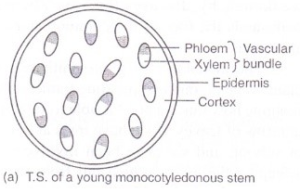
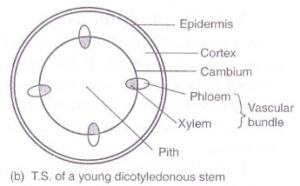
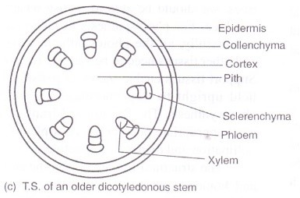
Distribution of tissues in stems
Monocots do not undergo secondary thickening unlike dicots. Monocots therefore consists of primary tissues only.
Dicots develop secondary tissues and are hence woody perennials.