Fossil Records
Fossils are remains of ancestral forms that were accidentally preserved in some naturally occurring materials over a long period of time.
Paleontology – study of fossils.
Importance of Fossils
- Show the type of organisms that existed at a certain geological period or age.
- Show a gradual change in complexity of life forms over time.
- Generate a complete evolutionary history of the development of certain organisms.
Determination of the Fossil ages
This is done by two methods;
- Radioactive dating (Carbon dating)
- Potassium argon method
Limitations of using Fossil Records in retraction of Evolutionary History
1.Presence of missing links.
This cause gaps in fossil records due to some part or whole organism being decomposed or scavenged upon.
2. Distortion of fossil parts during sedimentation giving wrong impression of the structures.
3. Destruction of fossils by geological activities.
e.g. earthquakes, faulting, uplifting and mass wasting.
Methods of fossil formation
- Petrification (change into rock)
- Impressions e.g. molds/casts
- Preservation/Entire organism or parts preserved
Types of fossils
- Actual animal/animal part
- Molds
- Casts
- Trace fossils e.g. footprints, burrows
History of Fossil Records of Man
This evolutionary history has been drawn by use of skulls, limb bones, teeth, skeletal fragments and cultural artefacts like primitive hand axes, scrappers, flakes, cave paintings, broken pottery etc.
Some Structural differences between Apes and Humans
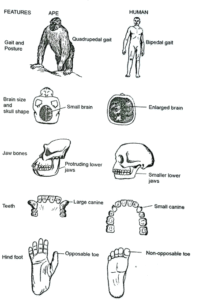
|
Apes (Gorilla) |
Human (Man) |
|
Opposable toe in hind foot for grasping tree branches. |
Non-opposable toe in hind foot, the foot is mainly used for stability on the ground. |
|
Omnivorous, with large incisors and canine teeth for defense and killing prey. |
Omnivorous, with reduced canine and incisors for feeding but not defense or killing prey. |
|
Large downwards protruding lower jaws for defence and prey holding. |
Smaller compact lower jaws for feeding. |
|
Enlarged cranium with low brain capacity 500cm3 and low learning capability. |
Greatly expanded cranium with higher brain capacity 1,350cm3 and higher intellectual capability. |
|
Uses forelimbs for walking on trees and on the ground. |
Use the two forelimbs (hands) for grasping and manipulation with an opposable thumb. |
|
Gait; walking on all four limbs i.e. quadrupedal. |
Gait; walking on two limbs i.e. bipedal |
|
Narrow and elongated pelvis. |
Broad, shorter more flattened pelvis. |