Chromosomal Mutations
This is the change in the structure or number of the chromosomes. Also called chromosome aberrations.
During crossing over in meiosis chromatids of homologous chromosomes intertwine at several points, the chiasmata. Breaking of chromosomes at the chiasmata creates plenty of opportunity for various changes on the chromatids leading to chromosome mutations.
Types of Chromosomal mutations
(a) Structural changes
- Deletion–loss or absence of genes
- Duplication–repetition of genes
- Inversion – reversal of gene sequence
- Translocation – transfer of part of a chromosome
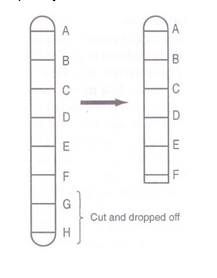
Deletion
Occurs when some sections (genes) of the chromatids break off and fail to reconnect to any of the chromatids. The sections are completely lost.
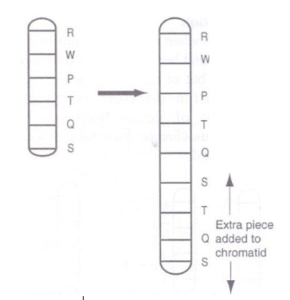
Duplication
Occurs when a section of a chromatid replicates/repeats and adds an extra length to itself.
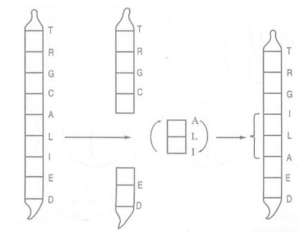
Inversion
Occurs when the gene sequence along the chromatid is reversed. A chromatid breaks at two places, and when rejoining the middle piece rotates and rejoins in an inverted position.
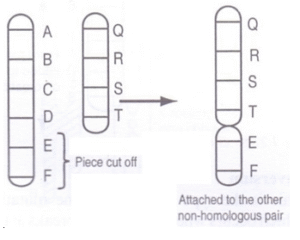
Translocation
Involves the movement of genes from one non-homologous chromosome to another. Occurs when a section of one chromatid breaks off and becomes attached to another chromatid but of the non-homologous pair.
(b) Changes in chromosome number
Non-disjunction
Involves the addition or loss of one or more whole chromosomes.
Consequences of Non-disjunction
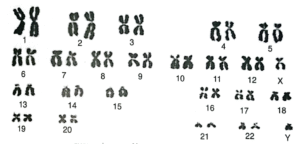
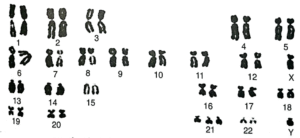
- Down’s syndrome
In these individuals, their cells have an extra chromosome (2n=47), due to failure of the 21st pair of chromosomes to separate during meiosis I.
Persons affected have low resistance to diseases, are mentally retarded, have a short thick body, slit eyes and may have heart abnormalities.
- Turner’s syndrome (XO)
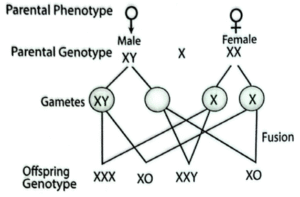
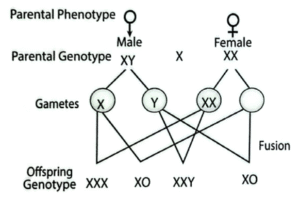
Shown by females (XO) who lack one of the X chromosomes.
They do not exhibit all the secondary sexual characteristics, some very short.
- Klinefelter’s syndrome (XXY or XXX)
Individuals have an extra set of sex chromosomes.
Male – XXY
Feamale – XXX
When it occurs in males with an extra X-chromosome (XXY). Such males develop some female secondary characteristics like growth of breasts. They are of low intelligence and have very small testes.
- Polyploidy
Presence of one or more extra sets of haploid number of chromosomes in a cell; e.g. 3n or 4n instead of 2n.
It may result from failure of cytoplasmic division in meiosis, producing diploid (2n) gametes.
It can also be induced artificially by use of chemicals that prevent formation of spindle fibres during cell division hence anaphase stage fails to occur.
Polyploidy is common in plants.
Advantages of Polyploidy in Plants
- Increased yields.
- Early maturation of plants.
- Resistance to diseases and pests.
- Drought tolerance.