Reflex Action
Reflex action is a rapid automatic response to a certain stimulus.
There are two types of reflex actions:
(a) Simple Reflex Action
(b) Conditioned Reflex Action
Simple Reflex Action
It is a specific single and automatic response to a particular stimulus.
It is the simplest form of reflex and does not depend on learning.
Examples include;
- Withdrawal of finger from a hot or sharp object.
- Blinking of the eye when an object passes close to it.
- Coughing and sneezing
- Secretion of tears when an onion is cut.
- Swallowing
- Enlargement of the pupil in different light intensities.
The structural basis of a reflex action is called the reflex arc, which is the pathway followed by the nerve impulse.
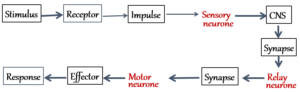
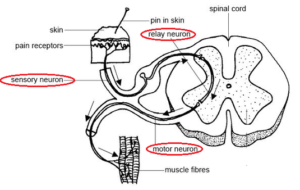
The simplest reflex arc is made up of three neurons; the receptors (sensory), relay and motor neurones.
They link the receptor with the effector through the spinal cord.
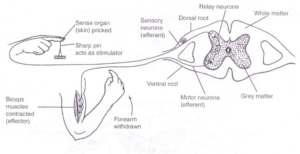
A simple reflex action involving withdrawal of the hand from a hot or sharp object
When the finger is pricked /touch a hot object, the pain receptors in the skin of the finger are stimulated. Nerve impulses are triggered off and transmitted via the sensory neurone to the grey matter of the spinal cord. The impulse is then transmitted to the relay neurone via a synapse then to the motor neurone through another synapse. Eventually through the ventral root the impulse is transmitted to the effector which is the bicep of the upper arm. The biceps contract and the forearm is withdrawn or raised.
Summary
Reflex
Conditioned Reflex Action
It is an automatic response to a different (unrelated) stimulus which is substituted for the normal one.
It is a learned response.
This is an automatic response which can be evoked from an animal by unrelated stimulus substituted for the one which normally elicits the response.
This reflex action is formed from passed experience. It involves modification of behavior through learning.
Example; in a simple reflex action, a dog normally salivates when it sees food presented to it. But if a bell is rung just before food is presented to the dog, and the procedure is repeated several times, the dog will learn to associate the bell ringing with food.
Therefore, it will salivate as soon as it hears the sound of the bell whether food is presented or not.
Ivan Pavlov, who carried out these interesting experiments on dogs, called this response conditioned reflex action.
The conditioned reflex usually weakens with time, therefore, it must be reinforced by repeated stimulus or repeating the original experience if the same result is to be obtained. This forms the basis of learned behaviour.
Examples of conditioned reflex action are walking, playing, cycling, writing, swimming and driving.
Question
Using a relevant example in each case, describe simple and conditional reflex actions.
(a) Simple reflex action
e.g. Withdrawal of finger from a sharp object/hot object; it’s an automatic response to a single specific stimulus; when the finger touches sharp object/ hot object, the pain receptors/ thermoreceptors in the skin are stimulated; and trigger off a nerve impulse; the nerve impulse is transmitted via the sensory neurone; to the grey matter of the spinal cord/Central Nervous System/ brain; the impulse is then transmitted via synapse; to the relay neurone; and then through another synapse; to the motor neurone; the impulse is then transmitted to the effector muscles in the hand; The effector muscles/biceps contract while the triceps relax; and the finger is withdrawn from the hot object/ sharp object;
(b) Conditioned reflex action
Salivation in a dog/human being/student in response to sound; it is an automatic response evoked from an animal by unrelated stimulus; substituted for the one which normally elicits the response; it develops from a past experience; and involves modification of behaviour through learning; it weakens with time; and must be reinforced by repeating the related stimulus; to achieve the same result the dog/ student salivates when the bell (for meals) rings; because they have learnt to associate the ringing of the bell at meal time with food; every time it rings they are offered food.
Differences between simple reflex action and conditioned reflex action
|
Simple Reflex Action |
Conditioned Reflex Action |
|
Single stimulus to bring about response. |
Repeated stimulus to bring about response. |
|
Simplest form of behaviour and is independent of experience. |
Involves modification of behaviour and dependent on experience. |
|
Sensory and motor components are the same at all times. |
Primary sensory component is replaced by a secondary sensory component but the motor component remains unchanged. |