Deoxyribonucleic Acid
Gene
It is a unit of inheritance
It is the heredity factor, which transmits traits from parents to offspring.
Genes are located at fixed points on chromosomes; each point is called a locus (loci).
Gene is chemical in nature in the form of a nucleic acid molecule called Deoxyribonucleic acid (DNA).
A gene is a section of the DNA on the chromosome made of chains of bases along the DNA strand.
DNA
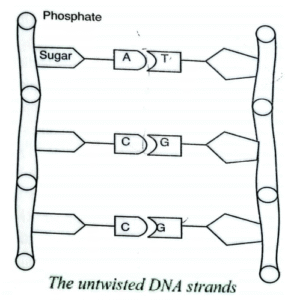
It is a complex molecule composed of three different components (that form a nucleotide);
- A five-carbon sugar – deoxyribose sugar
- A phosphate molecule
- A nitrogenous base
There are four types of nitrogenous bases;
- Adenine (A)
- Guanine (G)
- Thymine (T)
- Cytosine (C)
DNA consists of several nucleotides joined together to form long chains called DNA strands.
Adenine (A) pairs with Thymine (T) while Guanine (G) pairs with Cytosine (C).
Nucleotide initiates and controls protein synthesis
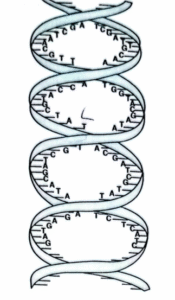
Two parallel DNA strands twist on one another forming a double helix.
The Role of DNA
- Stores genetic information in coded form.
- Enables transfer of information unchanged to daughter cells through replication.
- Translates the genetic information into the characteristics of an organism through protein synthesis.