Practical Applications of Genetics
- Genetic engineering
- Genetic counselling
- Blood transfusion
- Crime detection
- Plant and animal breeding
Genetic engineering
This is the genetic manipulation where an organism’s genetic constitution can be modified or altered.
Involves identification of a desirable gene, altering, isolating and transferring it from one living organism to another.
Through genetic engineering, it is now possible to make use of rapidly reproducing living organisms such as bacteria and fungi in the production of useful life-saving substances such as; antibiotics, vaccines, vitamins and hormones like insulin.
It has also been applied to produce genetically modified organisms (transgenes), which have resulted in increased crop and livestock production.
Gene therapy is the replacement of faulty genes with normal ones aimed at correcting genetic disorders
Genetic counselling
It is the provision of information and advice on genetically inherited disorders, their risks and outcomes.
It helps solve disputes on parentage of children by carrying out blood group tests and DNA matching on the couple and the child.
Blood transfusion
Transplant tests on blood groups and Rhesus conditions of the donor and recipient must be conducted before a blood transfusion is done. The donor’s blood should not have antigens that corresponds to the recipient’s antibodies otherwise agglutination would occur. A Rhesus negative person should not receive Rhesus positive blood since the person will produce antibodies against the Rhesus antigen. A subsequent transfusion with similar Rhesus positive blood would cause agglutination.
Crime detection
Forensic experts are able to carry out DNA tests on specimens such as hair, nails, bloodstains, body fluids, such as saliva and semen from crime scene and match them with suspected criminals to get the culprit(s).
Fingerprints are unique to each person. Fingerprint patterns from crime scenes are matched with those of suspected criminals to get the culprit(s).
Plant and animal breeding
With use of biotechnology, genetically modified organisms (GMO) with desired traits can be produced through artificial selection. Artificial selection is done by inbreeding or crossbreeding.
The phenotypic characteristics artificially selected include;
- Higher yields
- Early maturity
- Resistance to diseases and pests.
- Resistance to adverse environmental conditions.
- Yields with improved nutritional value.
Disadvantages of genetically modified organisms
- Most have lost original(desirable) qualities
- Product qualities are irreversible/can’t get original species/qualities
- Poor/undesirable qualities are perpetuated through subsequent generations
Cloning
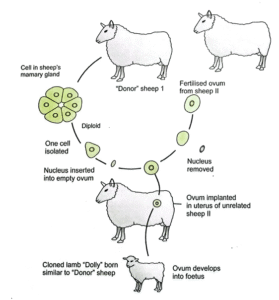
It is a type of reproduction where a group of cells arise from a single individual cell without fertilisation; e.g. tissue culture.
Human Genome
Genome is the total genetic content of any cell in an organism.
It comprises of all genes on all the chromosomes.
In human, there are up to 100,000 genes.
Aims of the Human Genome Projects:
- Gene mapping; is identifying specific positions occupied by specific genes on a chromosome e.g. sickle-cell anaemia is located on chromosome 11, haemophilia on the X chromosome.
- Gene sequencing; involves analyzing DNA to reveal the order of bases in all chromosomes.
Importance of the Human Genome Projects
- Identification of defective genes (hence facilitating their correction).
- Identification of genes that are susceptible to certain diseases (so that individuals can take preventive measures).
- Predicting the protein that a gene produces.