Muscles
Muscle is a tissue specialized for contraction.
Muscle contraction brings about movement.
Muscle have contractile myofibrils, protein in nature, which facilitate contraction and relaxation.
Muscle cells have numerous mitochondria to generate enough energy (ATP) for contraction.
There are three types of muscle;
(a) Skeletal muscle
(b) Smooth muscle
(c) Cardiac muscle
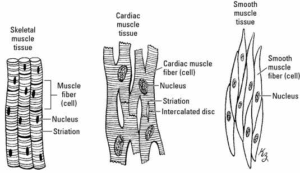
Skeletal Muscles
Are attached to the skeleton.
Play an important role in locomotion.
Have transverse striations hence described as striated (striped) muscles. Their fibres appear to have stripes running across them.
Are innervated by the voluntary nervous system hence referred to as voluntary muscles i.e. their contractions are controlled at will.
They contract and fatigue rapidly.
They are made up of a bundles of long fibres running the whole length of the muscle.
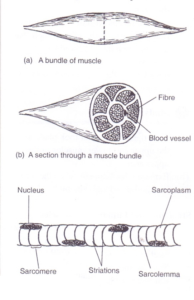
Each fibre is equivalent to one cell but containing many nuclei (multinucleated).
Each fibre contains many myofibrils running parallel to each other.
The covering of a muscle fibre is called a sarcolemma.
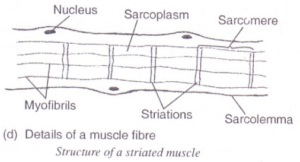
The functional unit of the muscle is the myofibril which has the ability to contract.
Muscles require large amounts of energy to contract.
The energy is provided by the numerous mitochondria present in the sarcoplasm.
Sodium and calcium ions are also necessary for muscle contraction.
The contraction of the muscle creates a force.
The force created by the contraction is transmitted onto the skeleton in the same magnitude by the tendon.
This brings about movement of the skeleton.
Smooth or Visceral Muscles
Found on the walls of the tubular visceral organs such as; reproductive tract, urinary tract, blood vessels, gut and respiratory tract.
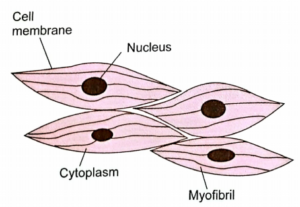
Have spindle-shaped cells with a single nucleus.
Contain myofibrils enclosed by plasma membrane.
Lack cross striations hence referred to as smooth muscles.
Are capable of slow involuntary contractions.
Are innervated by the autonomic (involuntary) nervous system hence are also called involuntary muscles.
Are capable of contracting slowly and fatigue slowly unlike the skeletal muscles.
Cardiac Muscles
Are the heart muscles.
Each muscle fibre consists of short cells with centrally placed nuclei and numerous striated myofibrils.
The ends of the cells are marked by thickened regions called intercalated discs.
These form bridges between the fibres hence transmit impulses rapidly throughout the heart.
The contraction of the heart muscle is generated from within the heart itself without nervous stimulation. Hence, the heart muscle is said to be myogenic.
The cardiac muscle is capable of continuous rhythmic contractions without fatigue throughout the life of a mammal.
They have more mitochondria than the skeletal muscle to sustain the energy demands.
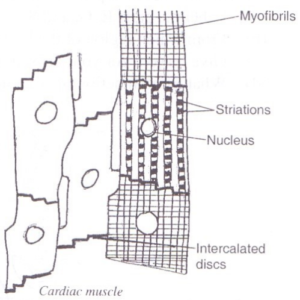
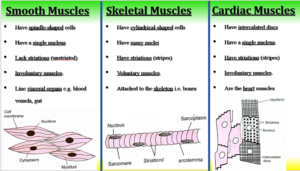
Differences between smooth, skeletal and cardiac muscles
Special properties of the Cardiac Muscles
- Do not fatigue
- Are myogenic i.e. contract and relax rhythmically without nervous stimulation.
Adaptations of the Cardiac Muscles
- Have numerous mitochondria to produce more energy for contraction without fatigue.
- Are myogenic hence contract and relax rhythmically without nervous stimulation.
- Have intercalated discs to enhance transmission of impulses rapidly throughout the heart.