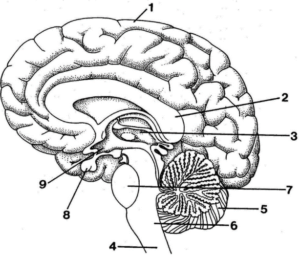
The Central Nervous System
The CNS is composed of the brain and spinal cord and their associated nerves.
The Brain

It is an enlarged anterior end of the spinal cord which is made up of a mass of nerve cells.
It coordinates and controls the activity of the nervous system.
The brain lies in and is protected by the cranium or skull in vertebrates.
The brain is covered by three protective membranes called meninges. These are:
(a) The dura mater
It is a tough outermost membrane that covers the brain and spinal cord.
It is composed of connective tissue and a rich network of capillaries.
(b) The pia mater
It is a thin innermost membrane that covers the brain and spinal cord.
It possesses many blood capillaries and lymph vessels.
(c) Arachnoid layer
It is a narrow space between the dura mater and pia mater.
It is filled with cerebrospinal fluid from which oxygen and nutrients diffuse into brain cells. Within the brain there is a system of cavities called ventricles which are filled with cerebrospinal fluid. This fluid is continuous with the spinal fluid of the central cord of the spinal cord. Cerebrospinal fluid is similar to lymph.

Functions of cerebrospinal fluid
- Provide nourishment to brain tissue.
- Serves as a shock absorber.