Role of Auxins in Tropisms
Auxins and Phototropism
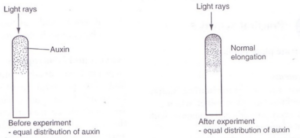
Under uniform light distribution, auxins produced from the shoot apex are translocated evenly down the shoot, therefore there is equal growth rate in the zone of elongation leading to normal increase in height of the shoot.
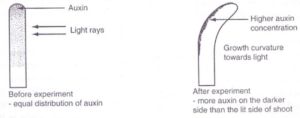
On exposure to unidirectional light; auxins migrate to the darker side of the shoot tip; Higher auxin concentration causes faster growth (elongation) on the darker side than lit side; hence growth curvature towards light.
Thigmotropism/Haptotropism
Contact with a hard object causes lateral migration of auxins to the side of the stem away from contact; Higher auxin concentration causes faster growth (elongation) on the outer part than the side in contact; hence the shoot tip continues to coil round the object.

Geotropism
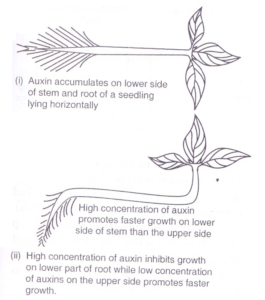
Due to gravity auxins migrate to the lower side of a horizontal stem; higher auxin concentration on the lower side in the shoot promotes faster growth on the lower side than on the upper side causing the shoot tip to grow upwards; while in the root, lower auxin concentration on the upper side promotes faster growth/elongation on the upper side than on the lower side, hence the root grows downwards