Role of DNA in Protein Synthesis
The sequence of the bases along the DNA strands act as the alphabet or code that spells out the sequence of amino acids. Every set of three bases along the DNA strands is responsible for bringing into position a particular amino acid of a polypeptide chain. The set of the base triplet is known as a codon, and is said to code for a particular amino acid of a protein molecule.
Examples of such DNA codons are:
- AAA coding for amino acid phenylalanine;
- TTT coding for amino acid lysine;
- CAA coding for amino acid valine;
- CTA coding for amino acid aspartic acid; etc.
Protein synthesis takes place in the ribosomes found in the cytoplasm. Since DNA molecules are confined to the cell nucleus, there has to means of communicating the DNA information to the ribosomes where protein synthesis occurs.
The cell has a special molecule that mediates between the DNA in the nucleus and the cytoplasm. This molecule is a nucleic acid called Ribonucleic acid (RNA). Because RNA carry genetic information from DNA to the site of protein synthesis in the cytoplasm, it is referred to as a messenger RNA (m-RNA) and is formed from the DNA strands.
In the formation of m-RNA, an appropriate section of the DNA strand serves as a template.
The double helix of the DNA unzips and free nucleotides align themselves opposite the template.
The base sequence of the template is copied onto a new strand, which then becomes an RNA strand.
In the RNA, Thymine (T) is replaced by the base Uracil (U). The transfer of DNA base sequence on to the m-RNA leaves the nucleus with the full instructions from the DNA about the kind of protein to be synthesized by the cell.
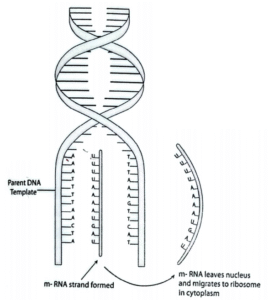
This instruction is in the form of the base triplets or codons; which are the practically used to assemble the amino acids on the protein polypeptide chains.
Information on the RNA is translated by the ribosomes and is used to assemble amino acids into specific protein molecules.
Protein molecules determine the inherited characteristics in organisms.