Natural Selection in Action
This is manifested in many areas such as;
- Industrial melanism
- Resistance against drugs and antibiotics pesticides
- Sickle-cell trait
Industrial melanism
In Europe, there are two forms of peppered moths, white and black.
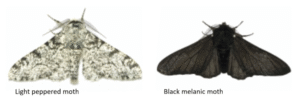
Before industrialization the tree trunks were white hence the white peppered moths were camouflaged. The black varieties were easily noticed and fed upon by predatory birds. The white form therefore reproduced and increased in number.
During industrialization the smoke from industries coated tree trunks black. The black variety became camouflaged reproduced and increased in population. The white variety were easily noticed and fed upon by predators. They reduced in population;
Resistance against drugs and antibiotics pesticides
When microorganism are continually exposed to a certain drug. Their cells mutate hence able to synthesise the gene for resistance, which is then transmitted to the offspring. Hence, increased population of resistant microorganims
For example: Mosquitoes possess a gene, which make them synthesise an enzyme against DDT. Control of Plasmodium (malaria parasite) has been made difficult due to ability of the Plasmodium to rapidly change its coat surface antigens. This makes the plasmodia resist the drug meant to kill them
Sickle-cell trait
It is known that there is high frequency of this mutant gene in places where malaria incidence is high. This is because those who are heterozygous HbAHbS have immunity to malaria, a situation called heterozygous advantage i.e. the heterozygous individuals are selected for.