SPINAL CORD
Spinal cord is the posterior extension from the brain to the tail.
It is enclosed in meninges and protected by the vertebral column.
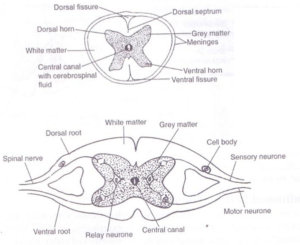
Spinal cord is made up of grey matter and white matter.
Grey matter
The grey matter relays information between the sensory and motor neurons.
It is H-shaped and surrounds a central canal which is filled with cerebrospinal fluid.
Functions of the CSF
- To nourish the nerve tissue
- Protect the nervous tissue against mechanical shock).
It consists of cell bodies and dendrites of relay and motor neurons that give it its darker appearance hence the term ‘grey’ matter.
White matter
Surround the grey matter.
It consists of the axons of sensory and motor neurons.
The myelin sheath of these neurons give this part its shiny white appearance.
Arising from the spinal cord are dorsal and ventral roots of spinal nerves.
Spinal nerves innervate the skeletal muscles of the limbs and trunk.
Spinal nerves in association with cranial nerves control all organs of the body below the head e.g. urinary bladder, the gut, liver, kidney and lungs.
Function of the Spinal Cord
- It links the nerves of the peripheral nervous system to the brain.
- It co-ordinates certain reflexes (automatic responses).
Describe the adaptations of the nervous system to its functions
- The brain is highly convoluted to provide a large surface area for impulse reception, processing and transmission.
- The brain and the spinal cord are protected by the meninges.
- The brain and the spinal cord have spaces/canals and ventricles filled with cerebrospinal fluid that nourish the brain cells and remove metabolic wastes.
- The brain has centres for storage, retrieval and processing of impulses.
- The cerebrum processes and stores information.
- The cerebellum sends impulses to joints and muscles to correct balance.
- The medulla oblongata sends impulses to the cardiovascular and breathing system to regulate them;
- The brain has the hypothalamus that sends secretes a neurosecretion to influence a pituitary gland that secretes hormones involved in reproduction and homeostasis.
- The hypothalamus detects changes in temperature and osmotic pressure and sends impulses to relevant effector organs for their regulation;
- The thalamus receives most of impulses and channels them to the relevant area of brain regions;
- The brain and spinal cord have grey matter that enable rapid processing /transmission of impulses.
- The nervous system has neurons that transmit impulses rapidly to and from the CNS ;
- Neurons have an electrochemical gradient that allow for generation of electrical impulses.
- Neurons have numerous mitochondria to produce more energy by sodium pump for polarization and depolarization during impulse transmission and refractory periods.
- The spinal cord has no integration functions hence its suited for reflex functions, needed in emergencies;
- The spinal cord is long and connects nerve fibres of the peripheral nerves with the brain for storage of information;
- The spinal cord has a dorsal root for sensory neurons and a ventral root for motor neurons.