Taxis/Tactic Response
It is a locomotory response to a unidirectional stimulus.
The stimulus is unidirectional, i.e. a stimulus from one direction (specific direction).
The responses are grouped according to the stimuli which cause them.
- Phototaxis (light)
- Aerotaxis (O2 concentration)
- Osmotaxis (osmotic pressure)
- Rheotaxis (wind/water currents)
- Chemotaxis (chemicals)
- Thermotaxis (temperature)
- Hydrotaxis (water)
Phototaxis – locomotory response to light intensity and direction.
Example; euglena, spirogyra and fruit flies move towards light. Wood lice, maggots and termites usually move away from light.
Aerotaxis – locomotory response to variations in oxygen concentration.
Example; Amoeba move from an area of low oxygen to high oxygen concentration.
Osmotaxis – locomotory response to variation in osmotic pressure.
Example; marine crabs burrow in the sand to avoid dilution of the body fluids.
Rheotaxis – locomotory response to variation in direction of water or air currents.
Example; fishes and planarians move against water currents. Butterflies and moths fly into wind currents in order to detect the scent of flowers.
Chemotaxis – locomotory response to variation of chemical changes in the environment of an organism.
Example; movement of the male gamete (spermatozoa) towards the female gamete (ovum). Mosquitoes fly away from insecticide repellants.
Thermotaxis – locomotory response to variation in temperature.
Example; paramecium move from low temperature (150C) area to moderate temperature (250C) area.
Survival Value of Tactic Responses
- Enable organisms escape from harmful stimuli e.g. excessive heat, predators
- Enable organisms to seek favourable habitats and acquire resources e.g. nutrients, and mates.
- Chemotaxis enables fertilisation to take place.
Question
The diagram below represents a set-up during an experiment.
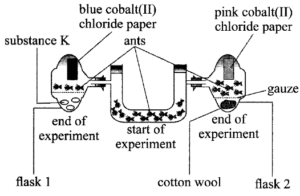
(a) (i) What was the experiment investigating?
- To investigate how ants respond to moisture/water/hydrotaxis
(ii) State the likely identity for substance K
- Anhydrous Calcium chloride/drying agent
(iii) Explain your answer in (ii) above.
- All moisture was absorbed hence cobalt (II) chloride remained blue
(iv) Account for the observations made in flask 2.
- More ants moved into the flask 2; due to presence of moisture/water vapour;