Transmission of Nerve Impulse
Resting Potential
A nerve impulse is an electrical charge or wave of disturbance arising from changes in ionic concentrations across the surface membrane of a nerve fibre (axon or dendrite).
The ions involved in impulse transmission are sodium ions (Na+) and potassium ions (K+).
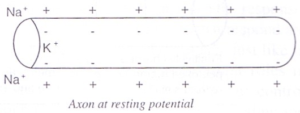
A non-conducting nerve fibre is described to be resting potential. In this state there are more Na+ outside the axon membrane than inside in relation to the concentration of K+ which is higher within the axoplasm.
There are also relatively more anions (negatively charged ions) within the axoplasm.
The net effect of this unequal distribution of ions is that there is positive charge outside the axoplasm and negative charge inside the axoplasm so that the membrane is said to be polarized.
During resting potential, Na+ are actively pumped out (extruded) by a mechanism called sodium pump.
Meanwhile, the K+ can diffuse freely in and out of the axoplasm.
Action Potential
An action potential is a localized change in electrical potential between the inside and outside of the nerve fibre when stimulated.
The inside becomes positively charged while the outside becomes negatively charged. This is called depolarisation.

The membrane becomes more permeable and because the sodium pump temporarily ceases, causing an influx by diffusion of Na+ into the axoplasm.
This raises the concentration of Na+ within the axoplasm relative to the outside, causing the K+ ions to diffuse out.
This localized charge stimulates the depolarisation of the membrane adjacent to it, thus propagating the depolarisation process.
This is immediately followed by a recovery to the polarized state.
The movement of this action potential along a nerve fibre constitutes an impulse.
