Sickle-cell Anaemia
The normal haemoglobin, a pigment in RBCs is replaced with one which makes the RBCs take a sickle shape instead of biconcave shape. Sickle shaped RBCs have less ability to carry oxygen.
Normal haemoglobin type A consists of two polypeptide chains. In the sickle-cell condition one amino acid, glutamic acid, is replaced by another acid valine, in each of the two polypeptide chains of the haemoglobin molecule. The resulting haemoglobin, known as haemoglobin type S is defective and has a marked difference from the normal one as a result of the substitution.
Sickle-cell anaemia is thus the condition where the individual is homozygous for the defective gene that direct the synthesis of haemoglobin S. Most of the individual’s RBCs are therefore sickle-shaped and the person frequently experiences oxygen shortage to the body tissues hence cannot carry out strenuous physical exercises.
The sickle shaped cells are not able to squeeze through capillaries.
They end up clogging blood vessels preventing normal blood flow.
This blockage results into severe pain in the joints, arms, legs and the stomach.
A less serious condition is the sickle-cell trait. This is a heterozygous condition where less than half the number RBCs are sickle-shaped. The rest of these cells are normal and are efficient in oxygen loading.
Individuals with the sickle cell trait have an advantage in surviving malarial attacks as compared to those who have normal haemoglobin.
Inheritance of sickle cell condition is a case of incomplete dominance.
|
Genotypes |
Phenotypes |
|
HbAHbA |
Normal haemoglobin |
|
HbAHbS |
Sickle cell trait |
|
HbSHbS |
Sickle cell anaemia |
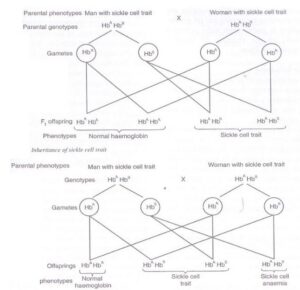
If a man with sickle-cell trait
sickle cell anaemia inheritance
(carrier) marries a normal woman, the probability that any of the offspring will carry the sickle cell trait is1/2.
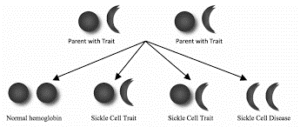
However, a marriage between two sickle cell carrier the probability of obtaining a sickle cell child is 1/4 while the probability of getting a child carrying the trait is 1/2.