DNA Replication
The DNA double helix consists of two long separate strands joined together by the base pairs. When the molecule is due to replicate the double helix unwinds and the two stands unzip themselves. This is made possible by the presence of the weak hydrogen bonds that link the bases of the two strands. Unzipping is therefore as a result of breaking of the hydrogen bonds thus setting each strand free from the other. After unzipping, the information on the DNA strands, that is the base sequence, is copied out onto a new DNA structure using the parent DNA as the template and thus, the parent molecule is said to have replicated itself. The replication makes it possible to pass on the DNA molecule together with its exact genetic information to daughter cells during cell division in the organism.
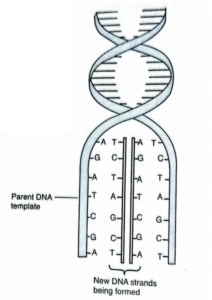
As the cell prepares for division during interphase, genetic material (DNA) replicates i.e. doubles itself so that sufficient DNA is made available for each of the daughter strands.