The Vertebral Column
Consist of bones called vertebrae.
There are 33 vertebrae in humans.
Vertebrae are separate from each other by cartilage called inter-vertebral discs.
Function of intervertebral discs
- Acts as a cushion that absorbs shock and reduce friction.
- Makes the vertebral column flexible by allowing for a certain degree of movement between the vertebrae.
Types of Vertebrae
There are 5 types of vertebrae.
- The cervical vertebrae – 7
- The thoracic vertebrae – 12
- The lumbar vertebrae – 5
- The sacral vertebrae – 5
- The caudal vertebrae – 4
They have a common basic plan.
Structures of a typical vertebra
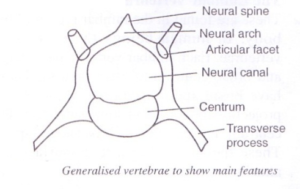
Centrum – a solid structure of the vertebra. It supports the weight of the vertebra.
Transverse processes – projections on each side of the neural arch. Offer surface for attachment of muscles.
Neural spine – projections found on the dorsal side of the neural arch. Provides surface for attachment of muscles.
Neural canal – a hollow part through which the spinal cord passes.
Neural arch – an arch of bones which arises from the centrum. Together with the centrum they protect the spinal cord.
Facets – surfaces for articulation with other vertebrae.
- Prezygapophyses – are facets found on the anterior side of the vertebra. They face upwards and inwards.
- Postzygapophyses – are facets found on the posterior end of the vertebra. They face downwards and outwards.