Movable Joints
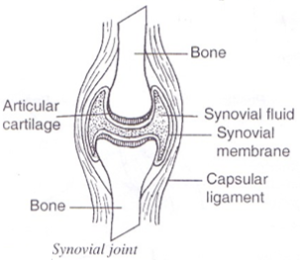
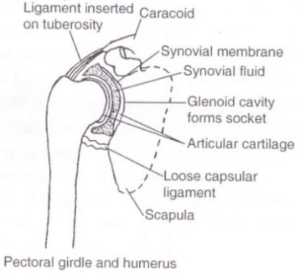
They are also called synovial joints because the joint area is filled with synovial fluid that lubricates the joint preventing friction between articulating bones.
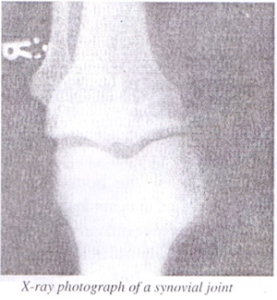
Types of synovial joints
(a) Ball and socket joint e.g. shoulder joint and hip joint.
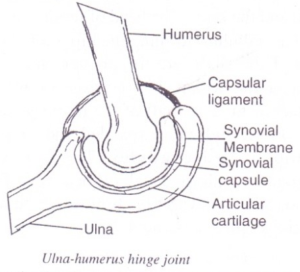
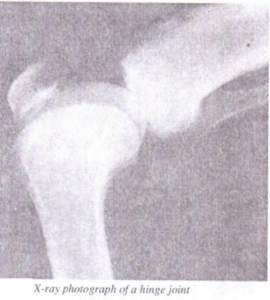
(b) Hinge joints e.g. elbow, knee joint and joints between phalanges.
Ball and Socket Joint
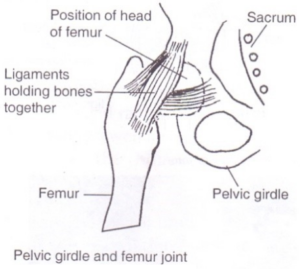
One of the two articulating bones has a rounded head that fits into the cavity (socket) of the other bone.
Movement is possible in all directions. The ball and socket joint allow the limbs to rotate through 3600.
These joints are unable to bear very heavy loads.
Functions of some parts of a synovial joint
(a) Synovial membrane
- Surrounds the synovial cavity.
- Secretes the synovial fluid.
(b) Synovial fluid
- Lubricates the end surfaces of articulating bones hence reduces friction.
(c) Ligaments
- Hold articulating bones together.
(d) Articular cartilage
- Reduce friction between bones.
- Absorbs shock
Hinge Joint
Has the basic structure of a synovial joint.
It allows movement in one plane only .i.e. through 1800
The maximum stretch of the limb at this joint is 1800.