Movement at a Joint
At a movable joint, the bones are held together by an inelastic tissue called a ligament. The ligaments restrain movement of the bones thus preventing dislocation.
At the joint muscles are attached to bones by an inelastic tissue called tendons. A muscle is attached at two points, the origin on an immovable bone and the insertion on a movable bone.
Muscles that operate joints are in pairs and are antagonistic.
Muscle that bring about bending at a joint are called flexor muscle while the muscle which straightens the limb is called extensor muscle.
Movement of the Forearm
The arm has two antagonistic muscles; the biceps and triceps.
The biceps are the flexor muscles while the triceps are the extensor muscles.
Contraction of the biceps muscles flex (bend) the arm while the contraction of the triceps extend (straighten) the arm.
When the biceps contract the triceps relax. This pulls the ulna-radius upwards hence bending the arm.
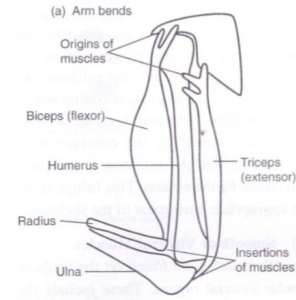
While the triceps contract the biceps relax thus straightening the ulna-radius leading to extension of the arm.
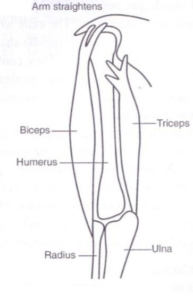
During this movement of the arm, the hinge joint at the elbow serves as the fulcrum with the biceps muscles providing the effort to lift the load at the forearm.
Give the structural and functional difference between a tendon and a ligament
|
Tendon |
Ligament |
|
Connect muscles to bones |
Connect bone to bone. |