The Endocrine System
It is the hormonal system.
Gland – is a group of cells that produce secretions.
A gland can be exocrine or endocrine.
Exocrine gland – have ducts hence secrete the products into the ducts e.g. sweat gland.
Endocrine gland – are ductless hence secrete the products directly into the bloodstream.
Some glands like the pancreas are both exocrine and endocrine.
Hormones are chemical messengers which are organic in nature.
Hormones are secreted directly into blood by the endocrine glands, and transported to specific target organs where they have their effects.
Role of Hormones
- Regulation of growth and development.
- Control of behaviour of animals e.g. breeding activities.
- Enhance proper functioning of cells.
The production of hormones from ductless glands is either directly or indirectly influenced by the nervous system.
The endocrine glands are located in various parts of the body.
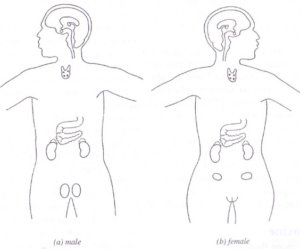
Pituitary gland is the master gland that controls the activities of the other endocrine glands.
However, its action is coordinated by the hypothalamus through nervous communication.
The hypothalamus influences the activities of pituitary gland by monitoring the level of hormones and other chemicals in the blood passing through it.
It also influences the secretions of the anterior lobe of the pituitary.
Hormones exercise control over their reactions through a feedback mechanism called negative feedback mechanism.
Negative feedback mechanism play an important role controlling many biological processes.
|
HORMONE |
GLAND |
TARGET |
FUNCTION |
|
Gastrin |
Stomach wall |
Stomach wall (gastric glands) |
Stimulates secretion of gastric juice |
|
Secretin |
Duodenal wall |
Pancreas |
Stimulates the secretion of pancreatic juice |
|
Cholecystokinin |
Duodenal wall |
Liver |
Stimulates the secretion of bile |
|
Insulin |
Pancreas |
Liver cells |
Stimulates the liver cells to convert excess glucose to glycogen for storage |
|
Glucagon |
Pancreas |
Liver cells |
Stimulates the liver cells to convert stored glycogen to glucose. |
|
Aldosterone |
Adrenal glands |
Kidney (nephron) |
Regulates the level of sodium ions by increasing the permeability of the kidney tubules to sodium ions |
|
Antidiuretic hormone |
Pituitary gland |
Kidney (nephron) |
Regulates the level of sodium ions by increasing the permeability of the kidney tubules to sodium ions |
|
Follicle stimulating hormone (males) |
Pituitary gland |
Testis |
Stimulate spermatogenesis |
|
Luteinising hormone (males) |
Pituitary gland |
Testis |
Stimulates secretion of testosterone/androgens |
|
Testosterone |
Testis |
Testis |
Stimulates the secondary sexual characteristics in males. |
|
Follicle stimulating hormone (females) |
Pituitary gland |
Ovary (Graafian follicle) |
Stimulates the development of the Graafian follicle in the ovary. Stimulate the ovarian tissues to secrete oestrogen. |
|
Oestrogen |
Ovary |
Uterine wall (endometrium) |
Stimulate the repair and healing of the endometrium, which is destroyed during menstruation Stimulate the anterior lobe of the pituitary gland to produce LH |
|
Luteinising hormone (females) |
Pituitary gland |
Ovary |
stimulates maturation of the Graafian follicle causing ovulation. stimulates the corpus luteum to secrete a hormone called progesterone. |
|
Progesterone |
Corpus luteum |
Uterine wall (endometrium) |
stimulates the thickening and increased blood supply to the endometrium. |
|
Oxytocin |
Pituitary gland |
Uterine wall (Myometrium) Mammary glands |
Stimulates contraction of the uterine wall (myometrium) leading to parturition. Stimulates milk release |
|
Prolactin |
Pituitary gland |
Mammary glands |
Stimulates milk synthesis |
|
Adrenaline |
Adrenal glands |
Body tissues |
Increases metabolism to prepare the body for emergency – fight or flight response |
|
Thyroxine |
Thyroid glands |
Body tissues |
Control metabolic rates Control growth Control involuntary activities like heart rate |